My Try Breeze Review as a Student with No Time and Lots of Stress
I am a psychology student. While I don't claim to be a mental health professional, I know that I personally need structure to be more productive and self-compassionate. But if you were in academia, you know how little time for planning and organizing there is left after completing all the readings and assignments.
Every "self-improvement" method fails for me: sticky notes, magnetic desks, writing everything down, having a comprehensive calendar, etc. It didn't help me with my impostor syndrome either. But I like to think of myself as a warrior. I kept looking for a way to be more productive.
I already tried a few mental health apps, and Breeze Wellbeing is one of them. This try Breeze review isn't about praising the app or my "perfect" consistency. But just my raw experience and recommendation, if you relate to my problems.

How I Used Breeze Wellbeing
Before I really started using Breeze, I set it up in a way I could realistically use it. Firstly, I personalized the space. Secondly, I added habits that I already have, not to start from a blank page (because I get frozen when starting a new project).
Now, let me explain how I used the Breeze Wellbeing app as efficiently as possible, given my limited time and energy. I chose to try Breeze to plan my time on a weekly and daily basis:
Once a week, I'd "rehaul" assignments and tasks I wanted to complete.
Daily, I adjusted that list based on my actual energy levels. I highly recommend doing this to avoid burnout and not turn something you do for yourself into a boring task. I've had enough experience with other apps to know that pressure kills consistency.
Regarding other features, I tried to use the journaling feature daily. I've tried paper journals before, but it was way too much hustle to carry them around and pressure to write "something wise."
With Breeze, journaling felt easier for me because it was always there. If I had a nice thought or a sudden worry, I could write it down in the moment. That immediacy made a huge difference.
When I felt overstimulated and reached for TikTok out of habit, I sometimes chose one of the relaxing games instead. It sounds small, but this sometimes helped me against mindless scrolling. Not always, but I try to appreciate progress more than perfection.
I study psychology, and honestly, I'm a bit tired of learning while I'm "off work," so I didn't push myself there. That's why self-discovery tests didn't stick for me, but I respect them for accuracy and not trying to be "mental health solutions."
What I Think About Breeze’s Features
In this section, I'd like to show what features stuck with me and which just weren't my cup of tea. My general impression of Breeze's features is that they feel like they are designed for real people with fluctuating energy, not for an idealized version of productivity.
Task planner
I’ve learned that simple to-do lists don’t work for me. I feel a lot of pressure, especially if I don't perfect my to-do lists. Breeze’s habit builder felt different, perhaps, because it is highly customizable.
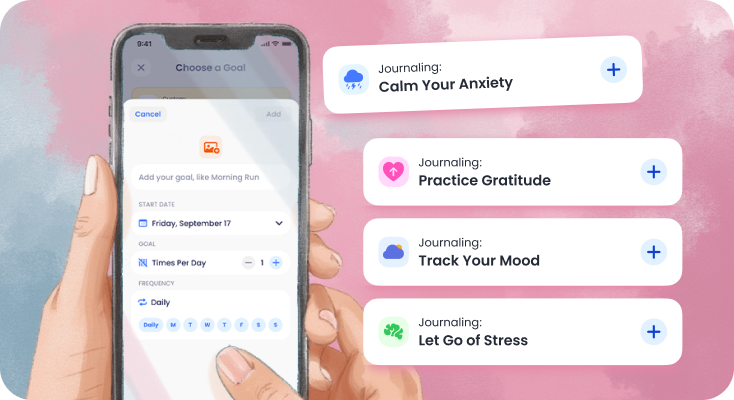
I could put deadlines, reminders, icons, repeativeness, and active days. Breeze's reminders also deserve attention because they are not invasive. I set them myself based on how often I need to be reminded of a task. It's something I didn’t see in other self-discovery apps.
Journaling
Journaling was by far my favorite feature. What was good:
I didn't need time to prepare or set aside time for journaling.
When I wanted to write something but didn't have ideas, I referred to existing prompts.
In days when academic stress overshadowed everything else, I simply used a mood tracker to replace journaling. It still has the same neurological effect: naming the emotion → better self-awareness → less anxiety symptoms. It's very low-effort, perfect for someone who doesn't have much time.
Mood tracker
I already mentioned how I used this feature. But just one more insight: it didn’t add much for me because I’m already fairly structured. However, I can clearly see how useful it could be in psychotherapy. Having mood data and notes could give a therapist concrete insights to adjust or guide sessions more effectively.
Quizzes and evaluations
I was pleasantly surprised by the self-discovery tests. As someone who studies psychology, I’m usually skeptical of app-based assessments, but many of the insights felt accurate and thoughtfully framed. I also liked the therapeutic language a lot. No jargonisms and terms. We are taught to talk exactly like that with future clients.
That said, I didn’t spend much time on them. Outside of studying, I didn’t always have the mental space to keep digging into the same topics. Also, I am in therapy and, hence, quite self-aware.
Affirmations
Affirmations were okay, but I think timing matters a lot with them. For my try Breeze review to be accurate, I wrote down some positive-thinking statements on my magnetic desk board, and they honestly made sense.
The problem is that I was usually too busy to reflect on them. So, I glimpsed, but didn't associate myself with affirmations. I’d probably benefit more if I intentionally stopped to think about these statements because a brain doesn’t see the difference between thoughts and reality, neurologically speaking. That’s why philosophers say that thoughts have physical power.
Games
The relaxing games worked better than I expected. They were simple but effective at interrupting the urge to open social media, which made me procrastinate.
In conclusion, Breeze didn’t feel like an app trying to change me. Vice versa, it was quite supportive. But I must admit it depends on how you use it, which I'll explain in the next section.
Would I Recommend Breeze for Academic Life?
Yes, but it heavily depends on how you use it. I have the privilege of studying psychology and being in therapy. So, I know what exactly is not worth doing:
Hoping that using Breeze will "improve" you, either through productivity or self-awareness. Because there's nothing wrong with you to improve it, to begin with.
Putting a responsibility on the app to "fix" your life. I'll hold your hand while I say it, but if you don't like something, you should do something about it. It's the beauty of life and free will, and also their curse.
Considering Breeze as "an aggressive optimizer." It's a self-discovery app first that additionally has planning tools. People who look for self-exploration will be more satisfied with it.
For me, Breeze fit into academic life as an emotional buffer. My primary expectation for trying Breeze for review was that it would be easy, not take a lot of time, and help me organize my thoughts. And it did exactly that for me. So, I can confidently recommend it to other students.


 Entrepreneurship