|
On This Page 1. What an At-Home Beauty Service App Is 2. The Service Catalogue and Spa Packages 3. Professional Booking and Matching 4. Trust, Safety, and Ratings 5. The Tech Stack and Architecture (2026) 6. Cost, Timeline, and Building It in India 7. Real Case Study: An Elegant, High-Traffic Booking Platform 8. Best Practices and Common Mistakes 9. FAQs |
Summary
Planning an at-home beauty app that users can trust? As the Marketing Head at Acquaint Softtech, I have seen how successful lifestyle platforms turn browsing into bookings through trust, seamless experiences, and reliable technology.
Our software product development services help businesses build secure booking, matching, and payment systems for on-demand platforms. With experience across global markets, we focus on creating beauty apps that feel safe, simple, and ready to scale.
The at-home beauty market is rapidly growing, mobile-first, where customers expect instant bookings like rides, and the entire experience depends on service listings, professional scheduling, and trust systems. Workforce data from the US Bureau of Labor Statistics shows how large the licensed beauty profession is, which is exactly why software that books, matches, and vets real professionals is what wins.
This article is a deep dive into building that platform, written from real delivery and market experience rather than generic, scraped advice. We will explain the model, cover the service catalogue and spa packages, go deep on professional booking and trust, then walk through the stack, the cost, and a real client build so the advice stands on shipped work. It sits inside our wider on-demand app development guide.
What an At-Home Beauty Service App Is
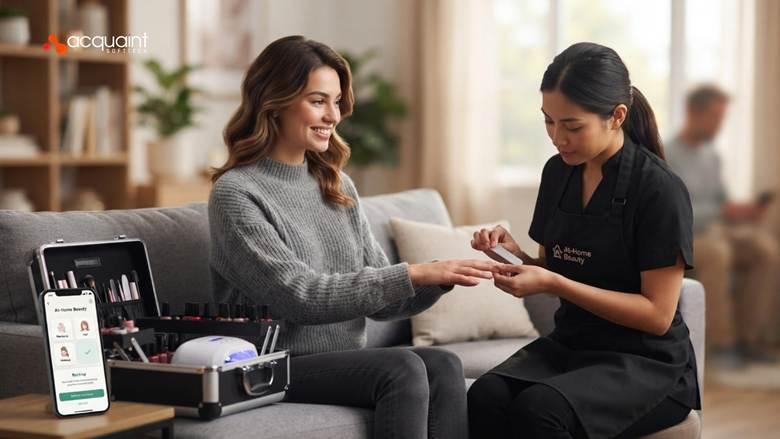
An at-home beauty service app is an on-demand platform that connects customers with vetted beauty professionals who deliver makeup, hair, manicure, and spa treatments at home, handling booking, scheduling, payment, and ratings in one flow.
The Yes Madam and Urban Company model is simple to state: a customer picks a service, the platform assigns a qualified professional, the treatment happens at home, and it is rated.
The difficulty is everything beneath that, especially trust and logistics, which is why serious operators bring in software development outsourcing partners rather than a template. Get the model right, and the features have somewhere solid to live.
The Yes Madam model in one view
At its core, this is a home-services marketplace with a beauty specialisation, and it shares the same DNA as other at-home platforms, which we cover in our on-demand home services app guide.
A customer, a professional, and an admin layer must stay in sync, while the product carries extra weight: appearance, hygiene, and personal comfort. Beauty also leans heavily on visuals, so the catalogue and professional profiles have to look as good as the service feels. Trust and presentation are the product, not extras.
Before building, the model and market have to be pinned down: which services and cities, employed professionals or a marketplace of freelancers, packages or single treatments, and how professionals are vetted.
Each answer cascades into the catalogue, the booking engine, and the trust model, so we map it in a discovery workshop first. A makeup-only app in one city is a different product from a full salon-at-home platform. Deciding this early is the cheapest decision you will ever make.
The Service Catalogue and Spa Packages
The service catalogue is the storefront of a beauty app, and it has to make a personal, varied set of treatments easy to browse, compare, and book. Makeup, hair, manicure, pedicure, facials, and spa treatments each have their own options, durations, add-ons, and prices, so the catalogue needs a flexible data model rather than a flat list. Building that structured, extensible catalogue is real backend work, which is why teams hire Laravel developers to model services, variants, and pricing cleanly. A messy catalogue makes even great services hard to sell.
Makeup, hair, manicure, and more
● Categories and sub-services: makeup, hair, nails, facials, and spa, neatly organised.
● Options and durations: variants, add-ons, and realistic time per treatment.
● Per-service and per-city pricing: prices that match local markets.
● Rich photos and descriptions: visuals that sell a personal service.
● Skills mapped to services: so only qualified professionals are offered.
Spa packages and bundles
Packages are how beauty apps raise order value and simplify choice, bundling a facial, a manicure, and a hair treatment into one bookable spa package at a set price. Packages need their own rules: total duration, the professionals required, and how they are scheduled into one visit. Done well, packages lift revenue and make booking effortless.
Catalogues and packages change constantly as a beauty business adds services, seasonal offers, and city-specific pricing, so the system has to be built to evolve. A clone with hard-coded services usually needs a painful version upgrade every time the menu changes. Designing the catalogue to be configurable from an admin panel saves that pain. Treat the menu as data the business controls, not code developers rewrite.
Professional Booking and Matching
Professional booking and matching is the engine that turns a tap into a confirmed home visit. When a customer books, the platform must find a qualified, available professional near them, confirm the slot, and account for travel and the treatment duration.
Building that matching and scheduling logic reliably is the focus of our dedicated development teams. A booking with no professional assigned, or the wrong one, is the fastest way to lose a customer for good.
How booking and matching work
Matching here is a close cousin of other on-demand platforms, pairing supply to demand by location, skill, rating, and availability, the same coordination we walk through in our on-demand delivery app development guide. Beauty adds its own constraints: treatments take time, professionals specialise, and customers often want the same professional again. The professional also needs an app for their schedule, navigation, earnings, and check-in. Matching is exactly where convenience is won or lost. Both the customer and professional apps live on phones, so the booking and schedule experience has to be fast and flawless on mobile.
Cross-platform delivery keeps them consistent and affordable, which is why teams hire React Native developers to ship both together. A professional fumbling a clumsy app in a customer's living room damages the brand instantly. Build for the real moment, not the demo.
Trust, Safety, and Ratings
Trust and safety are the foundation of a beauty app, because customers are inviting a stranger into their home for an intimate service. That means verified, background-checked professionals, clear hygiene and quality standards, in-app identity and safety features, and a rating system that reflects real experiences.
Modern platforms increasingly use AI development services to flag risky patterns and surface the best professionals. A single safety failure can end a beauty brand overnight.
Building trust into every booking
● Verified professionals: identity and background checks before they take a job.
● Visible ratings and reviews: an honest track record per professional.
● Hygiene and quality standards: clear, enforced, and visible to customers.
● Secure in-app payment: no cash at the door, full receipts.
● Safety features: live location, support, and post-visit feedback.
Verification and ratings only work if the data behind them is captured cleanly and stored securely, the same audit-ready data discipline behind the platforms in our Laravel project case studies. A rating must reflect skill, punctuality, and conduct, and a verified badge must be impossible to fake. Trust is an engineering outcome here, not a marketing slogan.
Smart platforms turn trust data into an advantage, predicting which professionals to promote, which bookings are at risk, and which customers will rebook. Teams building that layer often hire Python developers for the data and modelling work. A quality and trust score that quietly improves the whole supply is worth more than any single feature. Make trust measurable, then make it improve.
The Tech Stack and Architecture (2026)
A 2026 at-home beauty app pairs cross-platform mobile apps with a real-time backend, a flexible catalogue and booking engine, and secure payments. React Native or Flutter cover the customer and professional apps; a Node.js or Laravel backend runs the catalogue, bookings, matching, and payouts; and live updates ride over WebSockets and push. Many teams build on a single JavaScript foundation, so founders hire MERN stack developers who can own the customer, professional, and admin apps together.
Layer |
Recommended Tech |
Role |
Mobile apps |
React Native / Flutter |
Customer and professional apps |
Backend |
Node.js / Laravel |
Catalogue, bookings, payouts |
Real-time + jobs |
WebSockets, schedulers |
Matching, reminders, updates |
Data + cloud |
PostgreSQL, Redis, AWS |
Trust data, scale, uptime |
Why architecture beats any framework
Architecture matters more than any single library, because a beauty app blends a rich catalogue, real-time booking, and a trust system that must all stay fast and reliable. The backend choice between a PHP and a JavaScript stack is a genuine trade-off, which we weigh in Laravel vs MERN stack. Pick for your team and your scale, not for whatever is trending this quarter.
Integrations round it out: payments, maps, notifications, and identity or background-check providers, each with its own reliability and security demands. Owning those across multiple apps is why teams hire MEAN stack developers who can keep one consistent codebase. A clean architecture today is what keeps the platform fast and cheap to change tomorrow.
Cost, Timeline, and Building It in India
A focused at-home beauty MVP, with one city, a core catalogue, booking, a professional app, and ratings, typically starts in the mid-five figures, while a full multi-city platform with packages, advanced matching, and analytics runs into six figures. Timelines follow the same curve: a few months for an MVP, longer for a scaled platform. Teams keep both under control by hiring remote developers on a flexible model instead of carrying a fixed local payroll before revenue exists.
Build |
Typical Cost |
Timeline |
MVP, one city |
From ~$30,000 |
3 to 5 months |
Growth platform |
$75,000+ |
5 to 8 months |
Multi-city, full features |
$140,000+ |
8 months and up |
Why building in India changes the maths
Geography is the biggest single lever on what you spend. India-based teams deliver the same quality at up to 40% lower cost than Western agencies, the saving documented in our story on how a startup saved $60K a year on remote hiring. For a beauty app, that gap often funds the trust, safety, and visual polish that make customers comfortable booking. Cheaper hours buy a more complete, more trusted launch.
Cost is also about decisions made before any code is written. A weak catalogue model or a booking engine bolted on late can cost more than the original build to fix, so senior guidance early pays for itself. A virtual CTO can set the scope, the stack, and the hiring plan before money is committed. Spend on judgement first, code second, and the rest gets cheape.
7. Real Case Study: An Elegant, High-Traffic Booking Platform
The clearest proof of how we build an elegant, high-traffic booking platform is the website we built for Great Colorado Homes, a US real estate company, documented in our Great Colorado Homes case study.
Although it sells homes rather than haircuts, the engineering is exactly what a beauty app needs: a searchable, filterable catalogue of listings, appointment and tour scheduling, user accounts, and a fast, elegant, conversion-focused experience that performs at real scale. We built it custom so browsing turned smoothly into booked appointments.
|
● 50K+ Listings powering a massive and diverse marketplace ● 10K+ Monthly Users actively engaging and booking services ● 99.9% Uptime ensuring always-on reliability and trust |
Why it maps onto a beauty app
Swap a property for a beauty service and a tour booking for a treatment slot, and the primitives line up cleanly: a rich, searchable catalogue with advanced filters, scheduling that converts interest into a confirmed booking, user accounts, and an elegant, fast interface that holds up under real traffic.
These are the disciplines verified clients praise, summarised in our Clutch recognition overview, and you can browse more delivered work on our case studies page. The product differs, but the booking-and-discovery engine is the same.
Capability |
What we built for Great Colorado Homes |
Beauty app equivalent |
Searchable catalogue |
50K+ listings, advanced filters |
Services and professionals, filtered |
Scheduling |
Property tour booking |
Treatment and slot booking |
User accounts |
Buyer and seller accounts |
Customer and professional accounts |
Elegant, fast UX |
Responsive, multi-device |
Visual, mobile-first booking |
Proven at scale |
10K+ monthly users, 99.9% uptime |
Peak-time booking demand |
The lesson for a beauty platform is that a fast, elegant booking-and-catalogue engine lives or dies on a custom build you own and can extend, not a template you rent. A live beauty app also needs steady support and maintenance to keep the catalogue, bookings, and ratings running cleanly as services and cities grow. A booking platform is never finished; it grows with the menu.
Best Practices and Common Mistakes
Beauty apps fail in predictable ways, and most are about trust and experience, not looks alone. The biggest mistakes are launching with unvetted professionals, a rigid catalogue that cannot grow, a clumsy booking flow, and treating ratings as decoration. Avoiding those needs discipline and someone guarding the experience, which is why a strong project manager is worth more than any single feature on a busy build.
Get these right, avoid these traps
● Do: vet and background-check every professional.
● Do: build a flexible catalogue and packages from day one.
● Do: make booking and the professional app effortless.
● Avoid: a Yes Madam clone with shallow trust and a rigid menu.
● Avoid: launching with too few professionals to cover demand.
Choosing the right partner is the decision behind all the others. An experienced team designs for trust, a flexible catalogue, and smooth booking from the start. The difference our roundup of the best software product engineering companies explains in depth. The cold-start problem, an app with no professionals, is a strategy issue as much as a software one. Build supply and trust before you spend on marketing.
There is a faster route that is not a throwaway clone. A properly engineered white label solution you own and customise can give speed without the template trap, when built by a team that understands on-demand services. The right route depends on your timeline, budget, and ambition, which is the conversation worth having before a line of code is written.
FAQs
How does Yes Madam work?
Yes Madam is an at-home beauty service marketplace that connects customers with verified professionals. Users select a service and time slot through the app and get the service delivered at home. The platform assigns professionals, manages bookings, and handles payments and ratings.
How to build an at-home beauty app?
Start by defining your service model, target cities, and user flow. Build core modules like service listing, booking system, professional matching, payments, and admin panel. Launch a single city MVP first, then scale with performance and trust systems.
How much does a beauty app cost?
US |
UK |
Europe |
$30,000 – $140,000 |
£24,000 – £110,000 |
€28,000 – €130,000 |
What features does a salon at home app need?
A salon at home app needs a service catalogue, package system, and professional booking flow. It also requires verified professionals, secure payments, and real-time scheduling. Ratings, reviews, reminders, and an admin dashboard keep the system reliable.
What is an at-home beauty service app?
It is an on-demand platform where users book beauty services like makeup, hair, and spa at home. Verified professionals are assigned based on availability and location. The app manages booking, payment, and feedback in one place.
How does professional booking and matching work?
A user selects a service, time, and location inside the app. The system matches them with a nearby and skilled professional using availability, rating, and location data. The booking is then confirmed with automatic scheduling and route coordination.
Custom build or Yes Madam clone, which is better?
A clone is useful for quick validation or demo purposes. A custom build is better for real scaling, flexibility, and long-term control. Custom systems allow advanced matching, packages, and trust layers that templates cannot handle.
What tech stack is best for a beauty service app?
Frontend apps are usually built in React Native or Flutter for cross-platform support. Backend systems use Node.js or Laravel with databases like PostgreSQL and Redis. Real-time features rely on WebSockets and cloud infrastructure for scalability.


 Entrepreneurship