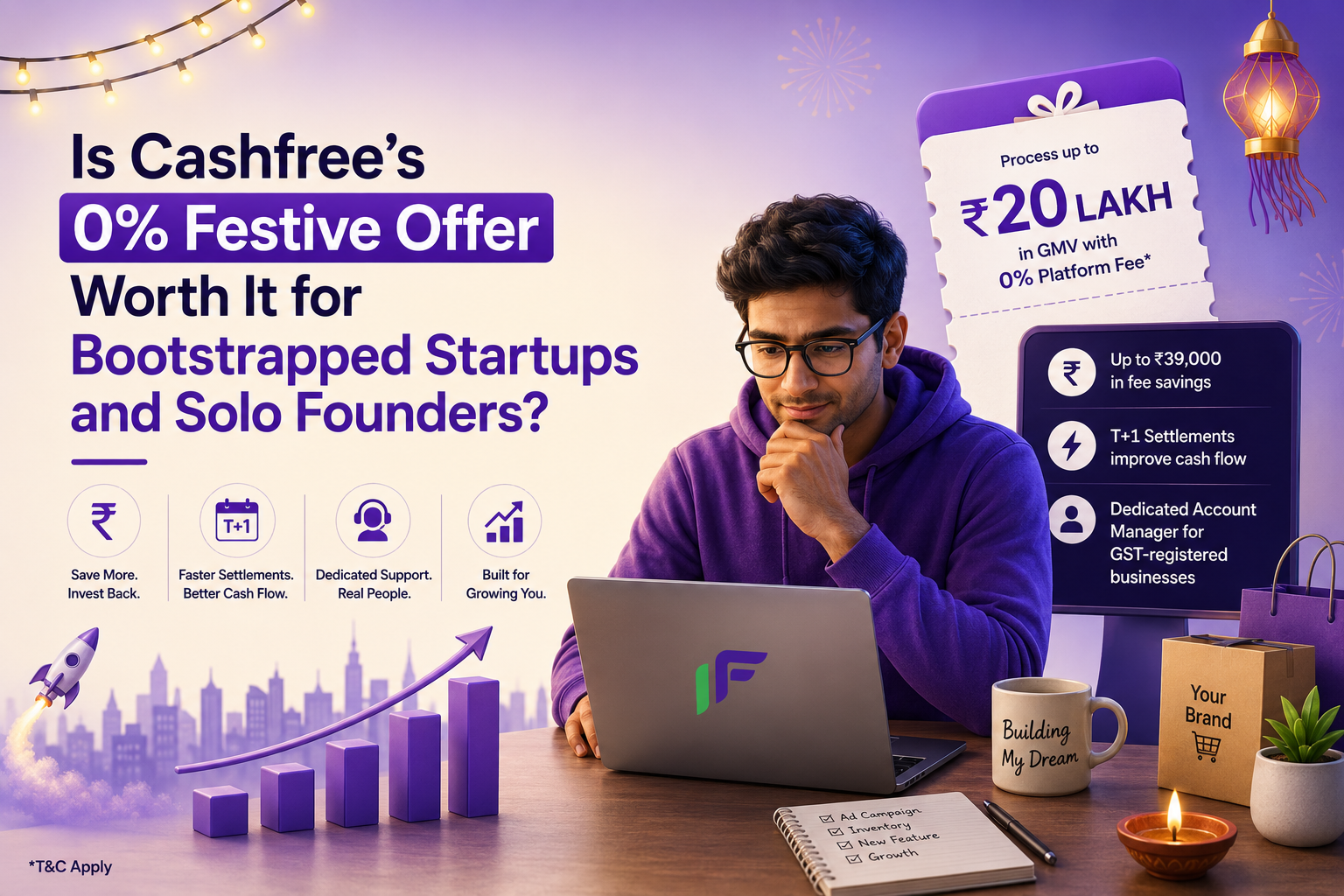
If you are running a bootstrapped business, ₹39,000 isn't a rounding error. It's next month's ad budget, or the difference between restocking on time and watching a bestseller go out of stock during your biggest sale week.
That's worth saying upfront, because most breakdowns of Cashfree's 0% festive offer miss what matters most to businesses that actually need this five-figure saving. For a solo founder or a pre-seed team running lean, the math reads completely differently. Not because the offer changes, but because what ₹39,000 means to your business changes.
What Is Cashfree Offering This Festive Season?
Cashfree is waiving its standard 1.95% platform fee on eligible domestic transactions for new merchants, allowing them to process a cumulative ₹20 lakh in GMV without paying platform fees during the campaign period. The offer is available to new merchants who sign up on or after 21 July 2026, complete KYC and activate their account, subject to the offer's terms and conditions.
The offer applies automatically once the account is successfully activated. There is no promo code, separate request or first transaction requirement. And that's the gist of the entire offer, but there are some important details that matter for a bootstrapped founder.
The ₹20 lakh is a cumulative offer limit, not an unlimited monthly waiver. Once the ₹20 lakh benefit is fully used, or the campaign ends, standard Cashfree platform fees of 1.95% plus applicable taxes apply automatically. The offer is also limited to eligible domestic Payment Gateway transactions. International transactions, AMEX and Diners Club cards, corporate credit cards, EMI, prepaid cards, Pay Later instruments, subscriptions and other excluded payment methods continue to attract standard pricing.
For a business doing ₹1-2 lakh in monthly payment volume right now and hoping to increase sales during the festive season, ₹20 lakh can still represent a meaningful amount of near-term payment volume.
How Does the Limit Actually Work for Startups and Solo Founders?
Large, funded D2C brands can utilise ₹20 lakh in GMV in days during a good festive sale. For them, the cap is a limitation rather than a benefit.
For a solo founder or a two-person team still finding product-market fit, ₹20 lakh might represent six months, or even a year, of total payment volume. That means the free window isn't necessarily a quick promotional blip that you can outgrow in a week; it can cover a meaningful portion of your near-term sales volume.
Put differently, the offer can be particularly valuable for someone bootstrapping their way from ₹50,000 a month to ₹2-3 lakh a month, where every transaction fee saved can go straight back into the business instead of into a payment gateway.
So when you run the numbers, this is how it looks:
At ₹5 lakh GMV, you save ₹9,750
At ₹10 lakh GMV, you save ₹19,500
At ₹20 lakh GMV, you save ₹39,000
That's based on Cashfree's standard 1.95% domestic platform fee.
To put that into perspective, ₹9,750 can cover a meaningful portion of an early-stage brand's next ad campaign, a small inventory reorder, or another operating expense.
For self-funded businesses, the cash would otherwise go towards payment-processing costs. Under the eligible 0% offer, that money can remain available for the business instead.
One thing founders should still do is check the exact tax and invoicing treatment applicable to their account and transactions when modelling the final cost. Don't assume that a headline 0% automatically means every payment-related cost disappears.
Money Aside, What Matters More for Startup Owners?
For a cash-constrained founder, settlement speed isn't a convenience feature; it's working capital.
Cashfree's standard domestic settlement cycle is currently T+1, which means eligible transaction proceeds are generally settled the following day rather than sitting in a longer standard cycle.
So, if you are a solo founder funding your own ad spend and inventory out of current revenue, the difference between T+1 and a longer settlement cycle can be the difference between reinvesting immediately or waiting for money that's technically already yours.
Now run this forward across a festive month with daily sales and you will see the difference.
A 24-48 hour settlement delay, multiplied across weeks, can quietly lock up capital you need to keep momentum going. For a funded brand, that's an inconvenience. For a bootstrapped founder, that delay can be the reason you miss restocking a bestseller mid-sale, which can cost you more in lost revenue than the fee waiver ever saved you.
There is another detail that matters when you're operating without a finance or payments team.
Cashfree currently offers a dedicated account manager to GST-registered businesses under its current pricing proposition.
A solo founder doesn't have a payments team, an ops lead, or anyone to escalate to when transactions start failing mid-sale. Having a dedicated point of contact instead of relying entirely on a generic support queue can matter when you are the only person handling customer complaints, inventory, and marketing all at once.
What Cashfree's Festive Offering Cannot Fix or Fit Into
To be fair, this offer isn't useful for every business.
If your business model depends heavily on EMI or Buy Now Pay Later instruments to push average order value, those transactions have their own pricing and aren't simply covered by the domestic 0% offer. Cashfree's current pricing lists Credit Card EMI from 1.90% and Pay Later at 2.20% under standard pricing.
Second, if you are selling internationally from day one, the domestic festive offer doesn't automatically apply to international card transactions. Those transactions have separate pricing. Cashfree currently lists international Visa and Mastercard transactions at 2.99% standard, with other international payment methods priced separately.
And if you scale fast enough to blow past ₹20 lakh in domestic GMV within a month, congratulations, and also, welcome to standard pricing on the incremental volume. Under the current terms, exceeding the ₹20 lakh threshold can also cause the promotional offer to be rescinded for subsequent months.
That's not really a downside specific to solo founders, but it's worth knowing that the free run has a ceiling.
So, Is Cashfree's 0% Offer Actually Worth It?
For a bootstrapped founder, the answer depends on whether your business fits the offer rather than simply whether you like the headline number.
If you're a new merchant, primarily processing eligible domestic payments, and expect to make meaningful use of the ₹20 lakh cumulative benefit during the campaign, the numbers are compelling.
At ₹5 lakh in eligible GMV, you're looking at a potential ₹9,750 saving against the standard 1.95% rate.
At ₹10 lakh, that becomes ₹19,500.
At ₹20 lakh, it reaches ₹39,000.
That's meaningful money when you're funding the business yourself.
And the value isn't limited to the fee waiver. T+1 standard settlement can improve working-capital flexibility, while dedicated account management for GST-registered businesses gives a small team access to a more direct support channel.
For businesses that need even faster access to funds, Cashfree also offers Instant Settlements as a separate service, with settlement options that can provide access to funds within minutes, subject to the applicable terms and charges.
Conclusion
For a bootstrapped founder or a pre-seed team doing anywhere from a few lakhs to ₹20 lakh in eligible domestic GMV, this isn't a marginal discount; it's closer to a working-capital advantage.
The fee savings alone can fund real decisions: ad spend, restocking, software, contractors or even one more hire.
Layer in T+1 settlement and a support structure that doesn't assume you have a large payments team behind you, and the offer becomes more interesting than a simple 0% headline.
If you are past that stage, funded, high-volume, heavily dependent on excluded payment categories, or selling primarily internationally, the calculus shifts. That's fine; the offer isn't designed to eliminate every payment cost for every type of business.
But if you are the founder still checking your bank balance before placing a supplier order, this is one of the more useful cases where a "limited-time offer" can line up with what your business actually needs right now.
The key is to check the fine print first. If you're a genuinely new merchant, process eligible domestic transactions, can make meaningful use of the ₹20 lakh cumulative benefit, and your payment mix doesn't trigger the fair-usage condition, the potential ₹39,000 saving is worth taking seriously.


 Entrepreneurship