
The Biggest Payroll Time Wasters (and Why They Persist)
Before you can fix the problem, you need to see it clearly. Here are the five payroll admin tasks that consume the most time in small businesses:
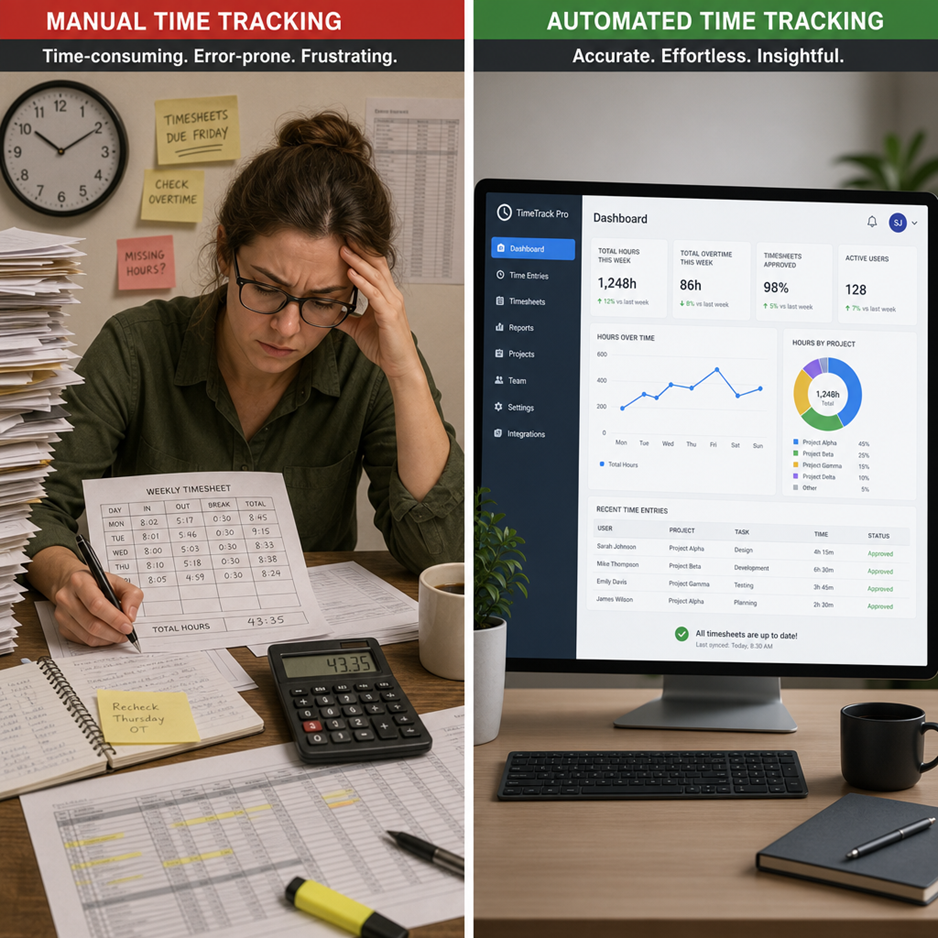
● Manually collecting and verifying timesheets. Paper timesheets and emailed spreadsheets require someone to gather, review, and reconcile data every pay period. This persists because many businesses started with a simple spreadsheet and never upgraded.
● Calculating overtime and leave accruals. Getting these numbers right requires tracking hours against thresholds that vary by jurisdiction and employee classification. Most small teams rely on manual math because their tools do not handle these rules automatically.
● Correcting payroll errors after the fact. A wrong rate, a missed shift, a miscategorized deduction. Fixing errors after a pay run takes longer than getting it right the first time. The IRS has noted that roughly a third of employers make payroll errors each year, and payroll errors cost employers billions in penalties annually. Manual processes are not just slow; they are expensive.
● Staying compliant with changing tax and labor regulations. Minimum wage updates, new reporting requirements, shifting overtime rules. Keeping up is a job in itself, and many owners default to hoping their current setup is still correct.
● Chasing employees for missing information. Whether it is an unsigned form, a forgotten clock-in, or an unapproved time-off request, the back-and-forth eats hours every week. It persists because there is no centralized system prompting employees to act.
These problems get worse as you grow. The process that worked fine when you had five employees starts breaking at 15 or 20. What was a minor annoyance becomes a serious operational bottleneck.

5 Practical Ways to Cut 12+ Hours of Payroll Admin Weekly
Each of these steps is something you can start implementing this month. None of them require a new hire.
1. Automate time and attendance tracking.
Replace paper timesheets and manual spreadsheets with a digital time-tracking tool. Employees clock in via a mobile app or a shared tablet, and their hours sync directly to your payroll system. For a team of 15 to 20 people, this single change can save three to five hours per week by eliminating manual data entry and the inevitable disputes over recorded hours. Many organizations use employee monitoring software to complement time-tracking data and improve workforce visibility.
2. Integrate your systems.
When your scheduling tool, time tracker, and payroll software operate as separate islands, someone has to manually move data between them. That means re-keying numbers, reformatting exports, and checking for discrepancies. Connect these systems so data flows automatically from one to the next.
The most effective approach combines scheduling, time-tracking, and payroll in a single workflow. An end-to-end employee management platform eliminates the need to export data from one system, reformat it, and import it into another. When your tools are purpose-built to work together, you reduce manual touchpoints and the errors that come with them.
3. Set up rules-based compliance alerts.
Use software that flags overtime thresholds, break violations, and leave balance issues before they become payroll problems. A proactive alert that fires when an employee approaches 40 hours is far cheaper than correcting an overpayment or dealing with a compliance penalty after the pay run.
4. Standardize your pay cycle workflow.
Create a repeatable checklist for each pay period. Define a timesheet approval deadline, a review window, and a final submission date. Write it down. Share it with your team. A consistent process eliminates last-minute scrambles and ensures nothing gets skipped. This is not glamorous work, but it is the kind of operational discipline that separates businesses that scale from those that stall.
5. Empower employees with self-service.
Let team members view their schedules, request time off, and check pay stubs through a self-service portal. Every question an employee can answer themselves is one less email or Slack message landing in your inbox. Self-service tools shift routine inquiries away from the business owner and back to the person who needs the information.
None of these five steps require adding headcount. They require a shift in process and a willingness to replace familiar (but broken) workflows with better ones.

What 12 Reclaimed Hours Actually Look Like for Your Business
Saving 12 hours a week sounds good in the abstract. But what does it actually mean for your business?
Think about what you would do with an extra day and a half every week:
● Refine your marketing strategy and actually execute on it
● Build deeper relationships with your best customers
● Improve your product or service based on real feedback
● Train and develop your team so they perform better without more oversight
● Step away from the screen before 8 PM without guilt
Many of the most successful startups grew not by throwing more people at problems but by removing operational friction. The same lean principles that apply to product development apply to your back office. When you stop spending your sharpest hours on data entry and error correction, you can invest them in the work that actually moves the needle.
Here is what the data shows: according to a Xero report on digital tool adoption, small businesses that automate admin tasks report stronger revenue growth compared to those relying on manual processes. Automation does not just save time; it creates the conditions for better decision-making.
And once you are not buried in payroll spreadsheets, you can focus on strategic fundamentals. Understanding the building blocks of a strong marketing mix, for example, becomes possible when your calendar is not consumed by admin. The constraint was never knowledge. It was bandwidth.
Start This Week, Not Next Quarter
Payroll admin does not have to consume your week. The path forward is not complicated: automate where you can, integrate the tools you already use, and standardize the process so it runs the same way every pay cycle.
You do not need to overhaul everything at once. Pick one change. Digitize your timesheets. Set up a compliance alert. Create a pay cycle checklist. Build momentum from there.
The businesses that grow efficiently are the ones that treat operational overhead as a problem to solve, not a cost of doing business. Twelve hours a week is too much to lose to work that software can handle.
If you are interested in how successful companies build operational efficiency into their DNA from day one, buildd.co has a detailed breakdown of how Airbnb scaled its growth strategy from zero to a global brand. It is a useful case study in doing more with less.


 Entrepreneurship